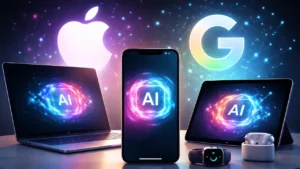
Apple is reportedly expanding its artificial intelligence strategy by gaining access to Google’s Gemini AI model. This move could allow the company to develop smaller and more efficient AI models that run directly on its devices.
Instead of relying fully on cloud-based AI, Apple appears to be focusing on improving performance and privacy through on-device intelligence.
Also read: ChatGPT Gets Library Feature to Store and Reuse Files Across Conversations
What Apple Plans to Do With Gemini AI
According to reports, Apple can use Gemini as a base model to train its own systems.
This involves a process called distillation, where:
- A large AI model is used to teach smaller models
- The smaller models learn how to perform tasks efficiently
- The final models are optimized for specific use cases
These models are expected to be lighter and faster while still delivering reliable results.
Why Smaller AI Models Matter
Apple’s goal seems to be building AI systems that work directly on devices like iPhones and Macs.
This approach offers several benefits:
- Faster response without relying on internet
- Better privacy since data stays on device
- Lower dependency on cloud processing
- Improved battery and performance efficiency
This is a key step toward making AI more practical in everyday use.
Gemini Could Enhance Siri
The integration of Gemini may also play a role in improving Apple’s voice assistant.
Future versions of Siri could:
- Handle conversations more naturally
- Provide more detailed answers
- Work more like a chatbot
There are also reports of a redesigned interface that could make Siri more interactive and modern.
Apple’s Hybrid AI Strategy
Even with access to Gemini, Apple is not abandoning its own AI development.
The company is expected to:
- Continue building its own AI models
- Combine them with Gemini-based insights
- Optimize everything for its ecosystem
This hybrid approach allows Apple to maintain control while using advanced technology.
Challenges in Integration
Working with an external AI model brings certain challenges:
- Aligning responses with Apple’s design style
- Ensuring consistency across devices
- Adapting the AI to different use cases
These factors will play a key role in how successful the integration becomes.
What This Means for Users
If implemented well, users can expect:
- Smarter AI features on iPhone and Mac
- Faster and more responsive assistants
- Improved privacy with on-device processing
- Better performance across apps
This could significantly improve the overall user experience.
Also read: Claude AI Now Able to Use Your Computer to Perform Tasks on Its Own
Final Thoughts
Apple’s reported access to Google Gemini AI shows a clear direction toward more advanced and efficient AI systems. By using distillation to create smaller models, Apple is aiming to deliver powerful features without relying heavily on the cloud.
This strategy could shape the future of AI on consumer devices, making it faster, smarter, and more secure.